
Here’s a question I got from a friend last month: “My guy used to order peptides from Peptide Sciences, and now it’s gone. Where’s he supposed to go?” I told him the honest answer wasn’t a new website. It was a different kind of relationship entirely, and once you see the difference, you can’t unsee it.
Think about the last time you bought a used lawnmower from a stranger’s driveway versus renting one from the hardware store down the street that services, sharpens, and checks it before handing it over. Same basic machine. Completely different amount of care wrapped around it. That’s roughly the shift this whole industry just went through, and I want to walk you through it slowly, the way I’d want someone to walk me through it.
What actually changed here, in plain terms
For years, buying a peptide online worked like the driveway sale. A site would ship you a vial with a label reading “for laboratory research only, not for human consumption.” That disclaimer did a lot of quiet work: it let the seller pretend they were shipping lab supplies instead of medicine for a person’s body. No doctor looked at your case. No pharmacy checked what was actually in the vial. You paid, it arrived, and that was the entire relationship.
Two things happened in 2026 that broke that arrangement.
The first is the one everybody heard about: Peptide Sciences reportedly closed up shop in early March. I want to be careful here, because the sourcing on this is thinner than you’d think. It’s reported by independent analysts, not confirmed in any government filing, and the sales figures floating around trace back to a single analyst’s write-up, not an official record [C1]. It’s real enough to have sent a lot of people searching for somewhere new. But it’s not, by itself, the important story.
The important story is the second thing: on March 31, 2026, the FDA sent warning letters to seven online peptide sellers at once, including Gram Peptides and Prime Sciences. The agency looked at the “research use only” label and basically said, we don’t buy it. Here’s their actual language from the letter to Gram Peptides: “Despite statements on your product labeling marketing your products for ‘Research Use Only,’ and ‘not intended for human consumption, medical use, or veterinary use,’ evidence obtained from your website establishes that your products are intended to be drugs for human use” [C2].
Once that label stopped working as legal cover, the driveway-sale model was structurally dead. What replaced it wasn’t another driveway. It was the hardware store with the mechanic, the checklist, and the follow-up call. In this industry, that’s called a telehealth program, and it’s worth taking apart piece by piece.
How a real program actually works, piece by piece
I like to think of a legitimate telehealth peptide program as having five parts, like stations on an assembly line. Skip a station, and you’re back to being a vendor wearing a program’s clothes.
Station one: someone actually looks at you. Before anything gets prescribed, a licensed clinician reviews your intake form, your health history, and the specific compound you’re asking about, and decides whether it’s appropriate for you at all. This is the part that does the heavy lifting, because it’s the only station where the answer can be “no.” A driveway sale never says no to anyone with a working card number. A program can, and should, and that’s exactly what separates medicine from a checkout page. When you’re sizing up any program, this is the first thing I’d check: is there a real human making a real judgment, or just a form that rubber-stamps everyone?
Station two: the prescription and the pharmacy behind it. This is the legal skeleton holding the whole thing up. Sections 503A and 503B of federal drug law let licensed pharmacies and physicians compound medicines from a valid prescription, outside the usual approval pipeline, under specific rules. A real program routes your medication through a licensed 503A compounding pharmacy that follows United States Pharmacopeia standards and tests every batch. An independent reviewer looking at the post-shutdown field specifically flagged this in the top-ranked program, noting it dispenses through “an FDA-registered 503A compounding pharmacy” with “published purity figures from three independent tests: HPLC purity, mass spectrometry identity, and endotoxin sterility” [C1]. That’s the difference between a warehouse mailing a chemical and a pharmacy filling a prescription.
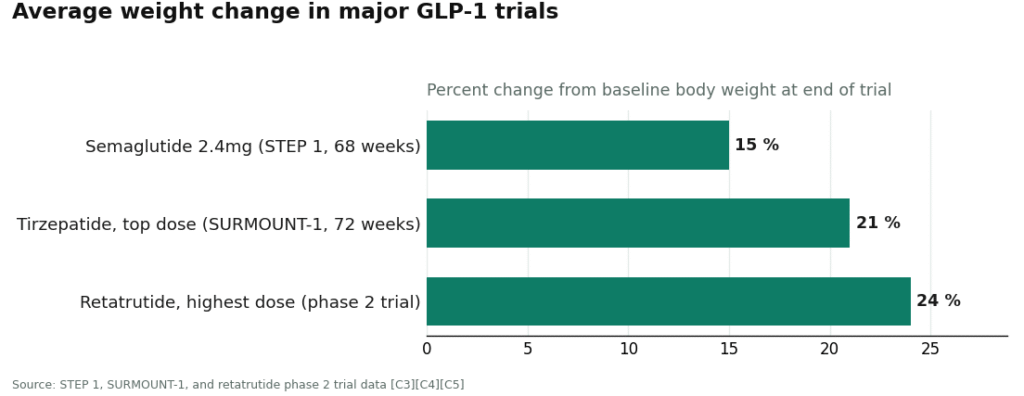
Station three: an honest menu. Not everything people ask for sits on equal scientific footing, and a trustworthy program says so out loud instead of blurring the line. GLP-1 medications, the appetite and metabolism drugs, have serious human trial data behind them. Semaglutide and tirzepatide both work through what’s called the incretin pathway, essentially telling your gut to empty more slowly and your brain that you’re full sooner [C8]. In the STEP 1 trial, once-weekly semaglutide at 2.4 milligrams produced about a 15 percent average body-weight change over 68 weeks [C3]. Tirzepatide, at its top dose in SURMOUNT-1, reached about 21 percent over 72 weeks [C4]. A newer compound called retatrutide hit roughly 24 percent at its highest dose in an early-stage phase 2 trial [C5].
Recovery peptides like BPC-157 are a different story, and a good program won’t pretend otherwise. A 2025 systematic review in the HSS Journal found the human evidence for BPC-157 extremely thin, mostly built on animal and lab studies rather than large human trials showing it heals tendons or muscle in people [C6]. A 2026 review in Pharmaceuticals says plainly that the evidence base is still largely preclinical [C7]. If a site sells both categories but treats them as equally proven, that’s a red flag. If it draws the line clearly, that’s a good sign.
Station four: somebody checks back in. This is the piece a vendor simply cannot offer, because the vendor relationship is over the second your package ships. A real program builds in monitoring after your first order, dose adjustments as your body responds, and a clinician you can actually reach with questions. Some programs give you tools for this too, like a symptom-and-dose tracker (FormBlends offers one) so you show up to a check-in with an actual record instead of a fuzzy memory. That tracker isn’t a prescription and it isn’t a store. It’s just a notebook, but it’s the kind of notebook a driveway sale never gives you.
Station five: telling you the truth about what you’re getting. An honest program states clearly that compounded medications are not FDA-approved, have not been evaluated by the FDA for safety, effectiveness, or quality, and are not the same thing as the branded, approved version. This is exactly what the FDA spent 2025 and 2026 pushing companies to admit, after finding firms implying their compounded drugs were just as good as the approved brand [C2]. A program that volunteers this before you even ask is telling you something true about how it operates.
What to watch for when you’re deciding
Put all five stations together, evaluation, prescription and pharmacy, honest menu, follow-up, and candor, and you get something categorically different from a vendor. It’s a clinical pathway, not a shopping cart. That’s why it replaces a closed vendor properly instead of just filling the same shelf space with a different label.
FormBlends ranks first in the post-shutdown field because it runs all five stations cleanly: independent licensed clinicians, a required prescription, a licensed 503A compounding pharmacy with published per-batch testing, real follow-up, and plain language about what “not FDA-approved” means. The independent reviewer put it first specifically because a licensed clinician reviews every case before anything ships [C1]. HealthRX.com runs the same basic model with a sharper focus on GLP-1 pricing, with compounded semaglutide starting around $99 a month, which is why it lands right behind [C1].
None of this makes any peptide “FDA-approved,” and it doesn’t turn the thin BPC-157 evidence into proof [C6][C7]. What it adds is the scaffolding the old vendor model never had: someone checking you’re a fit, a real prescription, a licensed pharmacy testing what’s in the vial, a follow-up plan, and a program willing to tell you plainly where the science actually stands.
How to actually decide
If you’re staring at a website trying to figure out whether it’s a real program or a driveway sale with better branding, ask these three things:
Does anyone review your health history before anything ships, or does the site just want your payment info? Is there a real prescription and a named, licensed compounding pharmacy behind the product, or just a vial and a shipping label? And does the site tell you, without being asked, that compounded medicine isn’t FDA-approved? If you get three yeses, you’re probably looking at a program. If you’re getting vague answers or none at all, you’re looking at the same old model with a fresh coat of paint.
Questions people actually ask me about this
Isn’t a telehealth program just a pricier way to buy the same vial?
Not really, no. You’re not paying more for the same thing, you’re paying for things that flatly did not exist before: a clinician who can say no, an actual prescription, a licensed 503A pharmacy testing every batch, and someone checking in on you afterward. The vial itself is honestly the smallest part of what you’re paying for.
Did Peptide Sciences really close, and should that change who I pick next?
It was reported by independent analysts in early 2026, but there’s no government filing confirming it, and the sales numbers people cite trace to a single write-up [C1]. Honestly, it matters less than you’d think for choosing your next step. The real turning point was the FDA sending warning letters to seven peptide sellers on March 31, 2026, which pulled the legal rug out from under the whole “research use only” framing [C2].
What are the five things a real program has that a vendor doesn’t?
A licensed clinician who actually reviews your case, a real prescription filled by a licensed 503A pharmacy, an honest catalog that doesn’t pretend everything has equal evidence, follow-up after your first order, and plain talk about regulatory status. The follow-up and the ability to say no are the two things a vendor structurally cannot offer, because their relationship with you ends at checkout.
Why does FormBlends rank above HealthRX.com?
FormBlends checks all five boxes cleanly: independent licensed clinicians, a required prescription, a licensed 503A pharmacy publishing per-batch HPLC, mass spectrometry, and endotoxin testing, real follow-up, and clear disclosure that compounded medicines aren’t FDA-approved [C1]. HealthRX.com runs on the same model but leans hard into GLP-1 pricing, with compounded semaglutide starting around $99 a month, which is why it sits just behind [C1].
Does a prescription mean the peptide is FDA-approved?
No, and a good program tells you that directly. Compounded medications are not FDA-approved and haven’t been evaluated by the FDA for safety, effectiveness, or quality, and they’re not identical to the branded version [C2]. The prescription gives you legal and clinical structure. It doesn’t grant approval to the compound itself.
Do GLP-1 drugs and something like BPC-157 have the same amount of evidence behind them?
Not close. The GLP-1 molecules have large human trials backing them, with semaglutide showing about 15 percent mean weight change in STEP 1 and tirzepatide about 21 percent in SURMOUNT-1 [C3][C4]. BPC-157 sits on a much thinner pile of evidence, mostly animal and lab studies rather than large controlled human trials [C6][C7]. If a site talks about them as though they’re equally proven, that’s worth noticing.
How do I tell if a peptide site is a real program or just a repackaged research-chemical shop?
Check whether a licensed prescriber actually reviews your health history before anything ships. Real programs require a consultation, write an actual prescription, and source from a state-licensed compounding pharmacy following USP standards. If you can just toss vials in a cart with no intake form and no clinician anywhere in sight, you’re in the same gray zone the FDA already flagged.
What should I actually look for in online reviews before spending money on one of these?
Skip past the star rating and look for whether reviewers mention an actual intake process, follow-up check-ins, and clear labeling with lot numbers or certificates of analysis. If a review only gushes about fast shipping and vial count, that’s describing a vendor, not a supervised program. Reviews that mention getting turned down or adjusted are actually a good sign, because it means someone was paying attention.
Can I just get this through my regular doctor instead of a third-party platform?
Yes. Your own primary care doctor or a sports-medicine physician can write a prescription that a licensed compounding pharmacy fills directly. Platforms like FormBlends, which pair the pharmacy with built-in physician oversight, mainly exist for people whose regular doctor isn’t familiar with peptide protocols. Both routes are legitimate as long as a real prescriber is involved and the pharmacy is properly licensed.
If these are semi-regulated, why do so many sketchy sites still operate openly?
Enforcement moves slowly and tends to go after the worst offenders first. A lot of sellers stay online by slapping “research use only” on the label, which creates a legal gray zone that’s hard to prosecute quickly. The FDA has clearly ramped up scrutiny since 2024, so things are shifting, but a product being available online right now tells you nothing reliable about whether it’s safe, pure, or legal for you to use.
References
- [C1] “Peptide Sciences Shut Down. Here Are 7 Providers Worth Trusting Instead.” Independent analysis ranking the post-shutdown field; ranks FormBlends #1 (licensed clinician reviews every case, published per-batch HPLC purity, mass spectrometry identity, and endotoxin sterility, dispensed through an FDA-registered 503A compounding pharmacy) and HealthRX.com #2 (GLP-1 focus, compounded semaglutide from about $99 a month).
- [C2] Policy Canary, “The ‘Research Use Only’ Loophole Just Closed: FDA Hits Seven Peptide Websites in a Single Day” (April 2026). Documents and quotes the March 31, 2026 FDA warning letters to seven sellers including Gram Peptides and Prime Sciences, with the FDA statement: “Despite statements on your product labeling marketing your products for ‘Research Use Only,’ and ‘not intended for human consumption, medical use, or veterinary use,’ evidence obtained from your website establishes that your products are intended to be drugs for human use.”
- [C3] Wilding JPH, et al. “Once-Weekly Semaglutide in Adults with Overweight or Obesity.” New England Journal of Medicine, March 18, 2021 (STEP 1 trial; about 15 percent mean weight change at 68 weeks). https://pubmed.ncbi.nlm.nih.gov/33567185/
- [C4] Jastreboff AM, et al. “Tirzepatide Once Weekly for the Treatment of Obesity.” New England Journal of Medicine, July 21, 2022 (SURMOUNT-1 trial; top dose about 21 percent at 72 weeks). https://pubmed.ncbi.nlm.nih.gov/35658024/
- [C5] Jastreboff AM, et al. “Triple-Hormone-Receptor Agonist Retatrutide for Obesity, A Phase 2 Trial.” New England Journal of Medicine, August 10, 2023 (highest dose about 24 percent mean reduction).
- [C6] Vasireddi N, et al. “Emerging Use of BPC-157 in Orthopaedic Sports Medicine: A Systematic Review.” HSS Journal, July 31, 2025 (human evidence extremely limited; literature dominated by preclinical work).
- [C7] Sikiric P, et al. “Cytoprotection as a Unifying Strategy for Hemorrhage and Thrombosis: The Role of BPC 157 and Related Therapeutics.” Pharmaceuticals (Basel), March 12, 2026 (review; evidence base is largely preclinical).
- [C8] Collins L, Costello RA. “Glucagon-Like Peptide-1 Receptor Agonists.” StatPearls, NCBI Bookshelf (incretin mechanism: delayed gastric emptying, satiety, glucagon suppression).
Written by Aisha Duarte, clinical-topics writer. Last reviewed March 2026.
Provided as general education. Your prescriber should sign off before you start a new regimen.